
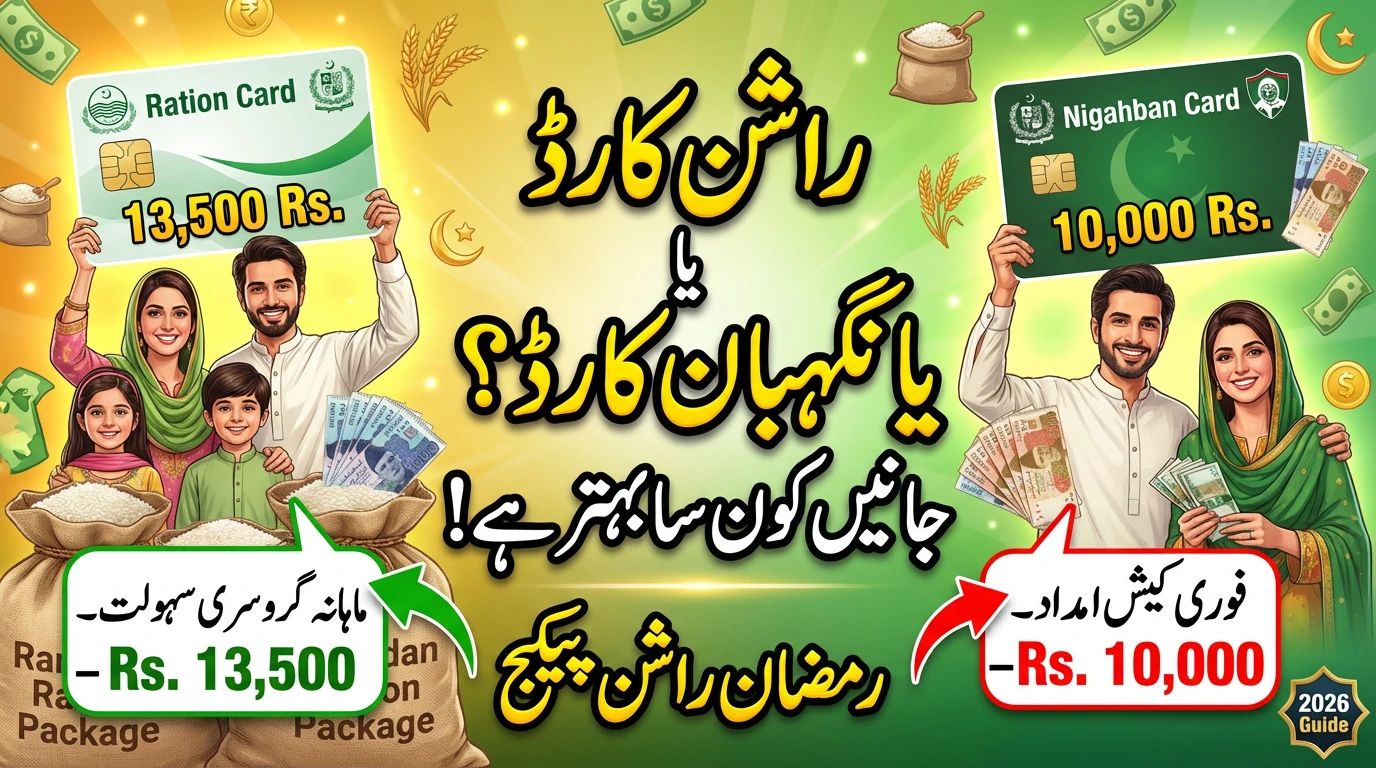
Many families in Pakistan hear about various government relief programs, especially during Ramadan and the rising effects of inflation. Two names come up frequently: Ration Card vs Nigahban Card. Often people are confused whether these two programs are the same or different, which one gives cash and which one provides ration.
It is very important to understand the difference between these two programs so that you apply for the right program and do not deprive your family of their rights.
In this guide, you will learn in simple terms:
- What is a Ration Card
- What is a Nigahban Card
- The main differences between the two
- Who can apply
- How to check eligibility
What is a Ration Card?
Ration Card is a government assistance program designed to provide low-income families with basic food items at a low price or free ration.
Main Objective
The objective of the ration card is to reduce the food expenditure of poor families.
Benefits
The benefits provided under the ration card may vary according to the province and the program:
- Subsidized flour
- Reduced sugar
- Concessions on ghee or cooking oil
- Dals and other basic commodities
- Monthly grocery subsidy
- Most ration card programs do not provide direct cash but provide food items or goods at a discounted price.
Eligibility
- These families are generally eligible if:
- They have a low income
- They are registered in a social or economic database (such as PSER or BISP)
- They have a valid CNIC
- They are permanent residents of the respective province
What is the Nighaban Card?
The Nighaban Card is a special relief program launched by the Punjab government to provide financial assistance to deserving families, especially during Ramadan.
Main Objective
The objective of the Nighaban Card is to provide immediate financial assistance to poor and deserving families.
Key Benefits
- Under the recent relief programs, eligible families can avail the following benefits:
- Cash assistance of Rs. 10,000 on specific occasions
- Ramadan Ration Packages
- Emergency Financial Assistance
- Special Relief for Registered Deserving Families
Key Differences Between Ration Card vs Nighaban Card
This is the most important part as most people confuse the two programs, but they are designed for different purposes.
| Feature | Ration Card | Nigahban Card |
|---|---|---|
| Main Benefit | Subsidized or free ration | Cash assistance and ration |
| Purpose | Reduce grocery expenses | Provide immediate financial relief |
| Payment Type | Mostly food subsidy | Often cash (e.g., Rs. 10,000) |
| Launch Type | Ongoing subsidy program | Special relief initiative |
| Best For | Monthly grocery support | Immediate financial help |
| Province Focus | Various provinces | Mainly Punjab |
To understand examples
Example 1: Ration Card
- Ahmed’s family has a ration card
- They go to the utility store
- Buy flour and sugar at a cheap price
- They do not get cash
Example 2: Nigahban Card
- Fatima’s family is included in the Nigahban Program
- They receive cash assistance of Rs. 10,000
- A Ramadan ration package may also be available on some occasions
- The money can be used for any household need
For both programs Eligibility
Although both programs help poor families, the eligibility rules may be slightly different.
General Requirements:
- Have a valid CNIC
- Be a low-income family
- Be registered in the government socio-economic data (PSER/BISP)
- Not a government employee
Preference for Nighaban Card:
- Pre-verified eligible families
- Family registered in PSER
- Family identified by the Punjab government
How to apply for a ration card
The process may vary from province to province but the general steps are:
- Get a valid CNIC
- Complete the PSER or BISP survey (if required)
- Check the announcement from the provincial government
- Register through the official portal or SMS service
- Wait for the eligibility confirmation
Points of use:
- Utility stores
- Registered grocery shops
- Government partner stores
How to apply for Nighaban Card
The Nighaban program is usually more targeted and does not require public registration at all times.
General Process:
- Complete PSER Survey
- Keep household data correct
- Wait for shortlisting from the government
- After receiving SMS or official notification, collect cash or ration as per the instructions
Important Tip:
Most of the families are selected automatically, hence it is very important to keep PSER data updated.
Common Mistakes People Make
- Considering Both Cards as Same
- Not Completing PSER Survey
- Trusting Agents or Middlemen
- Giving Wrong CNIC Information
How to Check Your Eligibility
- Through Official Government SMS Services
- Provincial Relief Portals
- Helplines like 1000 (Punjab)
- Local Administration Offices
Tip:
Keep your mobile number active as most of the verification comes through SMS.
Which one is better for you?
Choose Ration Card if:
- You want monthly grocery assistance
- Cheap food items are a priority
Choose Nighan Card if:
- Need urgent cash assistance
- Need Ramadan relief
- You are on the list of PSER poor families
Some families may be eligible for both programs, it depends on the government policy.
Official sources to trust
Official announcements of Punjab government
- PSER survey portal
- Official website of BISP
- Official press releases
- Do not always trust social media rumors
FAQS
What is the main benefit of a Ration Card?
It provides subsidized or free food items to reduce grocery costs for low-income families.
What is the main benefit of a Nigahban Card?
It gives direct cash assistance (e.g., Rs. 10,000) and sometimes ration packages for immediate financial relief.
Who is eligible for these programs?
Low-income families with a valid CNIC, registered in government socio-economic databases like PSER or BISP.
Can a family get both Ration and Nigahban Card?
Yes, some families may qualify for both depending on government selection and data verification.
How can I apply or check eligibility?
Through official provincial portals, SMS services, PSER/BISP registration, or government announcements.
Final Advice
Both Ration Card vs Nigahban Card are important relief programs, but their objectives are different.
- Ration Card: Provides affordable food items to families
- Niggaban Card: Focuses on immediate financial assistance, such as a cash assistance of Rs 10,000
Keep your CNIC and PSER data updated, follow government announcements, and never trust unofficial agents.
This way you can ensure that your family gets the relief it deserves.