
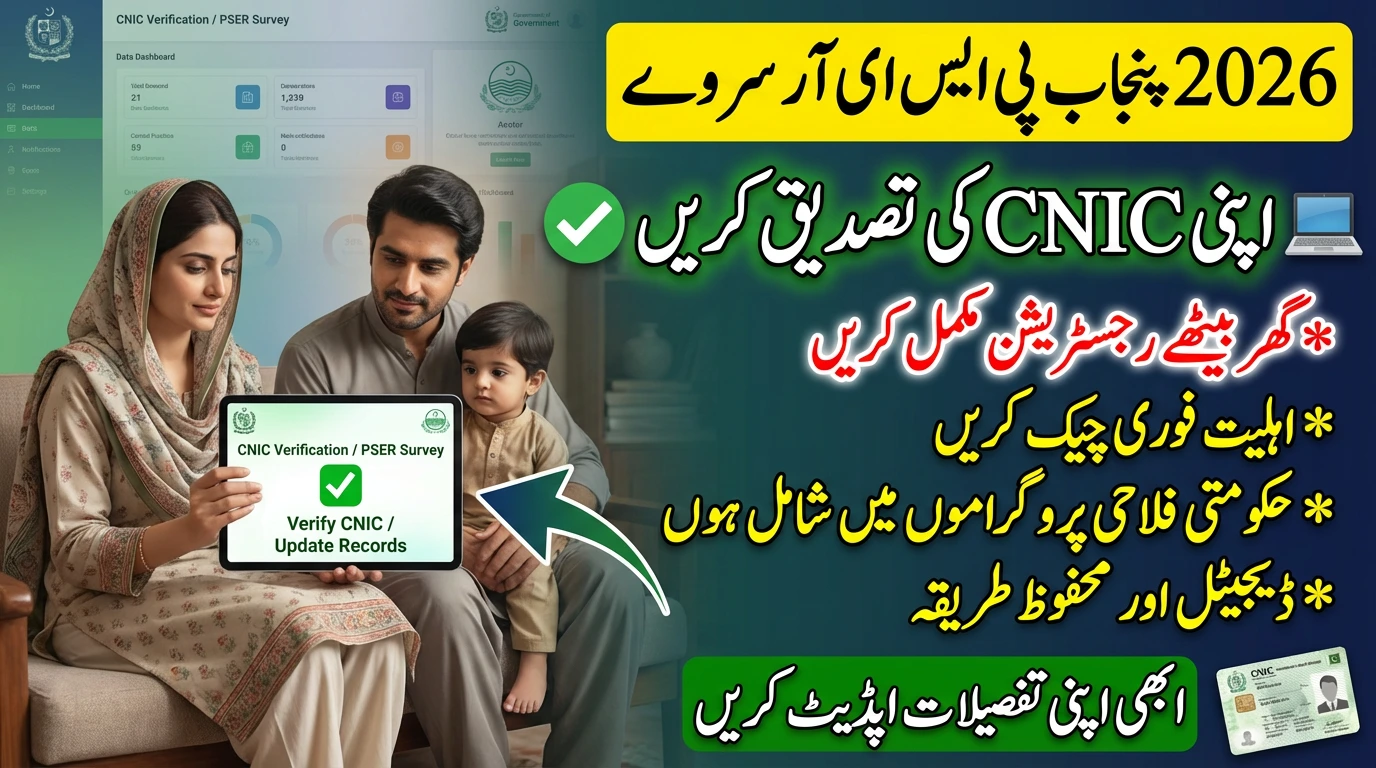
The Punjab Social and Economic Survey (PSER) Survey 2026 has been officially launched, with the aim of identifying low-income families across Punjab and giving them special attention so that they can be included in the program and provided with financial assistance. The aim of PSER is to check the records of poor and deserving individuals and accurately identify them so that they can be included in various programs of the Benazir Income Support Programme (BISP). Through this process, beneficiaries are declared eligible to participate in BISP programs after checking their eligibility.
This large-scale household survey is an important step to update household records and ensure correct eligibility for BISP, CM Ration Card, Ration Relief, Benazir Educational Scholarships, and other government welfare programs. This verifies whether beneficiaries will be able to join the BISP program after checking PSER. In this article, you will be informed about all this information.
Under the supervision of CM Punjab Maryam Nawaz, data of 30,000 households has been collected. PSER teams are going door to door to collect accurate and authentic data, especially from those families who were left out earlier or whose data could not be included in the initial survey. Families whose survey has been successfully completed will be automatically declared eligible for various BISP programs.
Understanding the PSER Survey 2026: Why It Matters
The main objective of the PSER survey 2026 is to ensure that financial assistance is delivered transparently only to the deserving and poor. Household circumstances change frequently, which is why old records sometimes include beneficiaries who are receiving financial assistance incorrectly, while many needy families are not included. Therefore, PSER ensures that only those who are truly in need are included in the program.
The Punjab government is ensuring a transparent and organized welfare system by collecting fresh and verified data through household visits. Moreover, the survey information is added to the Benazir Income Support Programme (BISP) and National Database and Registration Authority (NADRA) databases so that there is an accurate record of all beneficiaries. This process enables accurate poverty classification and verification of eligibility for various welfare programs.
Complete Guide to Door-to-Door PSER Survey 2026
This service is carried out by PSER through government teams equipped with secure digital tools, including tablets and mobile applications. The officers carry a green jacket and government ID card issued by the government. Families are advised to verify the identity of the team to avoid any possible fraud or scam so that they can be protected from the scheme.
- During the visits, the survey team performs the following tasks:
- Scanning the CNICs of all adult members of the household
- Recording the family composition, income, and education level
- Assessing household amenities such as electricity, water, and sanitation
- Recording all information digitally in real time
This process is designed to ensure transparency and accurate data collection.
Document Requirements
To speed up verification, families should have the following documents ready:
- CNICs of all adult members
- B-Form (Child Registration Certificate) for children
- Proof of income (salary slips, pension books, affidavits)
- Latest utility bills (electricity, gas, or water)
- Rent agreement or proof of home ownership
- Family Registration Certificate (if available)
Providing complete documents ensures faster processing and avoids delays in becoming eligible for welfare benefits.
Target Beneficiaries
The PSER Survey 2026 has been launched, and it has been launched in phases from urban and rural areas to collect accurate data of deserving families across Punjab. The aim of this survey is to fully identify low-income households so that they can be included in welfare programs.
The government’s target is to register more than 3 million low-income households, while in the initial phase, special focus is being given to the following families:
- Residents of remote villages
- Families living in informal settlements (slums)
- Households that could not be included in the previous survey
Through this initiative, the Punjab government is developing a comprehensive and authentic database so that timely financial assistance can be provided to the genuine beneficiaries.
Online Self-Registration via PSER Portal
Families who have not yet been visited by a survey team can register online through the PSER portal.
Steps for online registration:
- Visit https://pser.punjab.gov.pk
- Enter CNIC, mobile number, district, and tehsil
- Create an account using your details
- Log in with your credentials
- Complete the online survey form
- Submit for review and verification
How PSER 2026 Helps BISP & Ehsaas Beneficiaries
PSER data is linked to national and provincial welfare initiatives. Households not included in the updated PSER record are declared ineligible. Eligible households can avail the following benefits:
- Benazir Income Support Programme (BISP) under Rs 13,500 installment
- Free or subsidized rations under Punjab Ration Schemes
- Scholarships under Benazir Educational Scholarships
This system ensures fairness and prevents multiple members of the same household from claiming benefits simultaneously. Only one eligible applicant per household will be approved based on the poverty score so that the assistance reaches the genuine beneficiaries in a fair and transparent manner.

How Technology Is Improving PSER Survey 2026
The 2026 survey introduces digital improvements to enhance accuracy and transparency:
- Real-time data entry via mobile applications
- Direct NADRA CNIC verification
- AI-powered scoring for poverty assessment
- Biometric verification for added security
These upgrades reduce errors, prevent duplication, and increase trust in the welfare system.
Verification and Approval Process
After survey completion:
- Data is cross-verified with NADRA, BISP, and other government income databases
- Each household receives a poverty score (0–100)
- Families scoring 32 or below qualify for most assistance programs
- Eligible households receive SMS confirmation regarding inclusion in BISP, Rashan Riayat, or Taleemi Wazaif
- Names are automatically added to payment and ration lists
Benefits of Completing the PSER Survey 2026
| Program Name | Benefit | PMT Score Requirement |
| BISP Kafalat | Rs. 13,500 quarterly cash transfer | 32 or below |
| Benazir Taleemi Wazaif | Monthly scholarships for children | Mother’s PMT ≤ 32 |
| Ehsaas Ramzan Package | Subsidized food items during Ramadan | 40 or below |
| CM Punjab Rashan Card | Rs. 10,000 subsidy or ration support | 40 or below |
| Sehat Sahulat (Health Card) | Free hospital treatment | 32 or below |
FAQs
What is PSER 2026?
A Punjab survey for CNIC verification and social program registration.
Who can register?
All Punjab residents with a valid CNIC.
How is CNIC verified?
Survey teams visit homes for door-to-door verification.
Can I register online?
Yes, online registration is available through the official PSER portal.
Why is this survey important?
It ensures eligibility for programs like BISP and Ehsaas.

Final Thoughts
The PSER 2026 survey is an important opportunity for Punjab households to update their information and strengthen their welfare benefits. Whether your family was previously excluded or needs to update their records, completing the survey ensures access to financial assistance, healthcare, educational scholarships, and food subsidies.
By cooperating with the survey teams, you can get your name re-registered and complete your registration in various Benazir Income Support Programme (BISP) programs. Providing the survey team with accurate information and documentation plays a key role in ensuring your registration in BISP programs so that you can receive timely and merit-based assistance.